
Leukocytes are white blood cells (WBCs)
– leuk/o- = white
– -cyte = cell
• There are five types of leukocytes, which are identified by their granules and nucleus
• Leukocytes are categorized in two ways
– Granulocytes have granules in their cytoplasm
– Agranulocytes do not have granules
1. Neutrophils
Neutrophils make up 54-62% of leukocytes
– They are the most common leukocyte
– They are granulocytes, with many large granules
– The granules remain neutral when stained
– Their nucleus has many lobes and segments
– They develop in the red marrow, and eventually become an immature band or stab
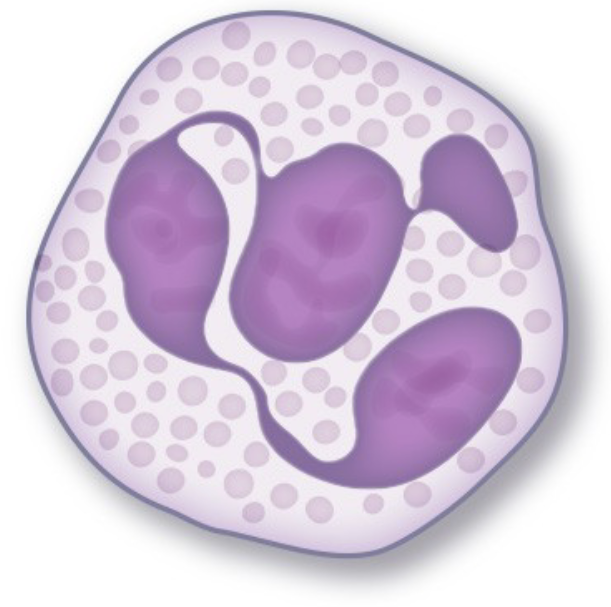
A neutrophil has many large, pale granules in its cytoplasm. These granules do not stain well with either a red, acidic dye (eosin) or with a blue, alkaline dye (hematoxylin).
Neutrophils get their name from their neutral reaction to these dyes. The nucleus has many segments and lobes.
2. Eosinophils
Eosinophils make up 1 to 3% of leukocytes
– They are granulocytes, with many large granules
– The granules stain pink when exposed to eosin
– Their nucleus has two lobes
– They develop in the red marrow from stem cells
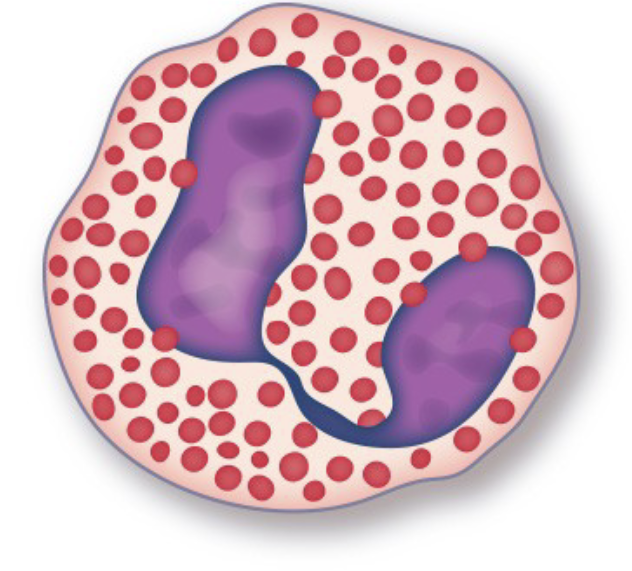
An eosinophil has many large, pink-red granules in its cytoplasm.
These granules stain with a red, acidic dye (eosin).
Eosinophils get their name from their reaction to this dye. The nucleus has two lobes.
3. Basophils
Basophils make up 0.5-1% of leukocytes
– They are the least common leukocyte
– They are granulocytes, with many large granules
– The granules stain blue when exposed to hematoxylin
– Their nucleus has more than one lobe
– They develop from stem cells in the red marrow
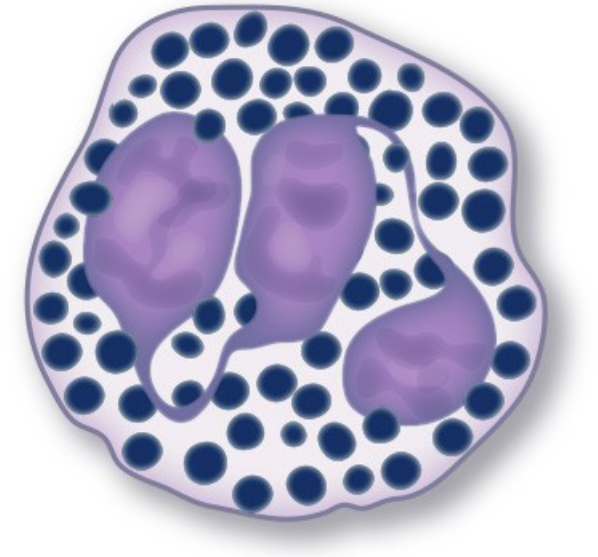
A basophil has many large granules in its cytoplasm. These granules stain dark blue to purple with a blue, alkaline dye (hematoxylin).
Chemically, something that is alkaline is known as a base, which is the opposite of an acid.
Basophils get their name from their reaction to this dye, which is a base. The nucleus has more than one lobe.