
Acquired immunodeficiency syndrome (AIDS)
Severe infection caused by the human immunodeficiency virus (H IV), a retrovirus that infects helper T cell.
Initially, there is a fever, night sweats, weight loss, enlarged lymph nodes, and diarrhea.
HIV is usually transmitted by sexual intercourse with an infected person, but it can also be transmitted:
• When intravenous drug abusers share needles
• When healthcare workers have an accidental needlestick and are exposed to infected blood
• From transfusions with infected blood
• From an infected mother to the fetus or from the breast milk to a nursing baby.
As large numbers of helper T cells are infected and destroyed, the action of suppressor T cell lymphocytes dominates.
This suppresses the normal immune response; the person becomes immuno-compromised and
defenseless against other infections and cancer.
• immun/o- immune response
• defici/o- inadequate; lacking
• -ency condition of being; condition of having
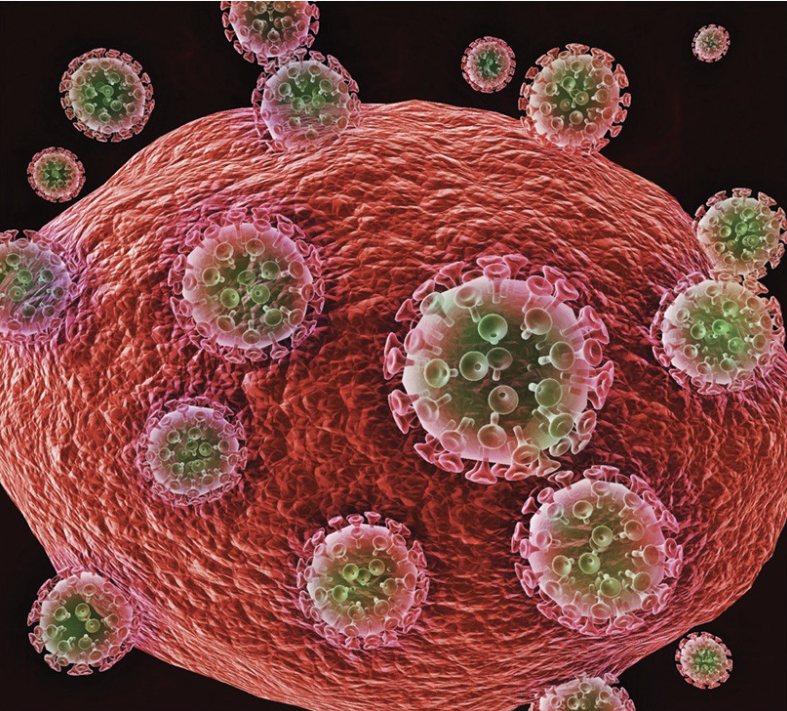
A helper T cell lymphocyte being attacked by many small human immunodeficiency retroviruses.
Like all viruses, HIV cannot reproduce itself.
It must enter the lymphocyte and use that cell’s DNA to reproduce.
When the lymphocyte is destroyed, the new retroviruses within it are released into the blood to infect other lymphocytes.
Leukemia
Cancer of the cells in the red bone marrow.
There are two main types of leukemia: myeloid and lymphoblastic.
In myeloid leukemia, excessive numbers of extremely immature myeloid stem cells are produced.
In lymphoblastic leukemia, excessive numbers of immature lymphoblasts are produced.
The cancerous cells crowd out and stop the production of other cells in the red bone marrow, causing anemia (too few erythrocytes), easy bruising and hemorrhages (too few thrombocytes), fever, and susceptibility to infection (too few mature leukocytes).
The onset of symptoms is either acute (sudden and severe) or chronic (mild
and continuing).
Leukemia can be caused by a genetic mutation, a family history of leukemia, or by exposure to radiation or toxic chemicals and drugs.
A diagnosis of leukemia is made by examination of the blood and by performing a bone marrow aspiration to examine blood cells in the red bone marrow.
• leuk/o- white
• -emia condition of the blood; substance in the blood
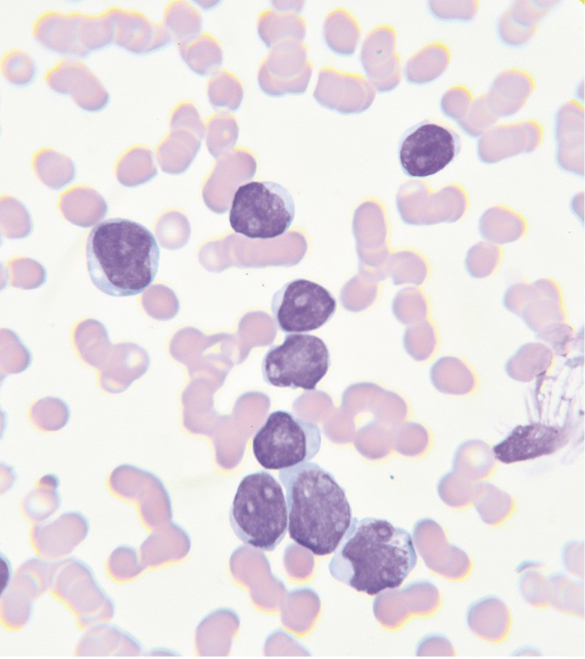
This blood sample was taken from a patient with acute lymphoblastic leukemia.
There was a sudden and dramatic increase in the number and size of immature lymphoblasts; only a few, smaller mature normal lymphocytes still remain in the blood.
The pale cells in the background are erythrocytes.
Mononucleosis
Infectious disease caused by the Epstein-Barr virus (EBV).
There is lymphadenopathy, fever, and fatigue. It is often called the “kissing disease” because it commonly affects young adults and is transmitted through contact with saliva that contains the virus. Also known as mono.
• mon/o- = one
• nucle/o- = nucleus
• -osis = abnormal condition
Multiple Myeloma
Cancer of B cell lymphocytes that would normally become plasma
cells and produce antibodies. This results in weakness, anemia,
and increased susceptibility to infection. Multiple tumors in the
bone destroy the red bone marrow and cause pain and bone
fractures. Bence Jones protein, an abnormal antibody produced
by the cancerous B cell lymphocytes, is identified in the urine.