
Anemia
Anemia is a decrease in the number of erythrocytes. A patient with anemia is anemic . Causes of anemia include:
• Insufficient amounts of amino acids, folic acid, iron, vitamin B 6, or
vitamin B 12 in the diet
• Disease, cancer, radiation therapy, or chemotherapy drugs that damage or destroy the red bone marrow
• Hemolysis with loss of erythrocytes because of increased cell fragility
• Hemorrhage, excessive menstruation, or chronic blood loss.
Aplastic anemia
Anemia caused by failure of the red bone marrow to produce erythrocytes because it has been damaged by disease, cancer, radiation therapy, or chemotherapy drugs.
In aplastic anemia, each erythrocyte is normocytic (normal in size) and normochromic (normal in color), but there are too few erythrocytes.
• a- away from; without
• plast/o- formation; growth
• -ic pertaining to
Folic acid deficiency anemia
Anemia caused by a deficiency of folic acid in the diet.
This anemia occurs in persons who are malnourished, older adults with a poor diet, alcoholics, and
pregnant women.
Each erythrocyte is macrocytic (abnormally large).
Iron deficiency anemia
Anemia caused by a deficiency of iron in the diet or by an increased loss of iron due to menstruation, hemorrhage, or chronic blood loss.
The mucous membranes and skin (especially the palms of the hands and the soles of the
feet) of a person with anemia will be paler than usual because iron gives erythrocytes their color.
Each erythrocyte is microcytic (small in size) and hypochromic (pale in color)
Microcytic, Hypochromic Erythrocytes
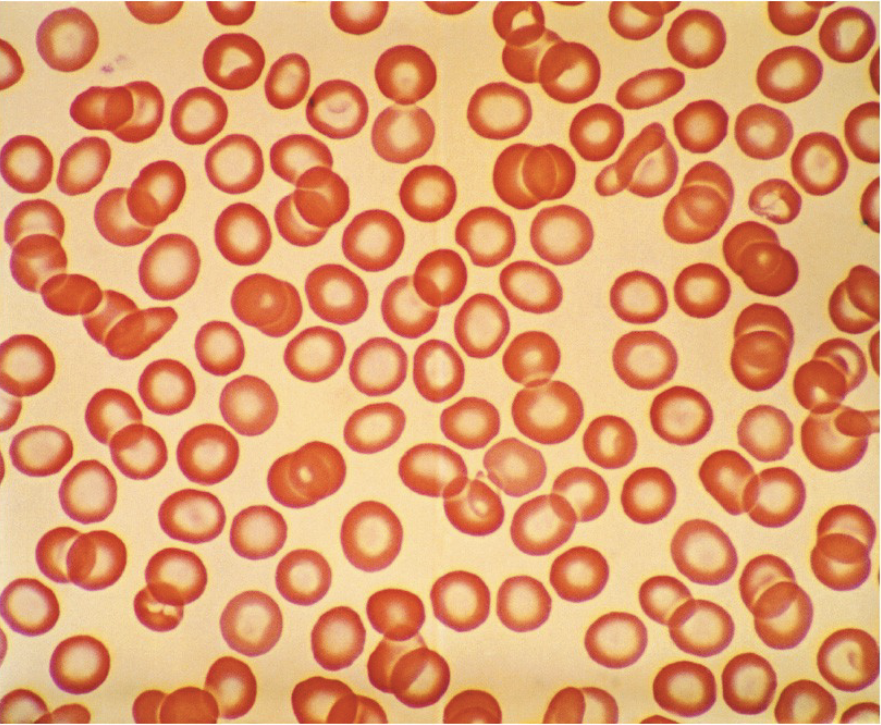
Under a microscope, this person’s blood has many centrally pale erythrocytes that are microcytic, hypochromic, and characteristic of iron deficiency anemia.
Pernicious anemia
Anemia caused by a lack of vitamin B12 in the diet or by a lack of intrinsic factor. Intrinsic factor, produced by the stomach, helps the body absorb vitamin B12. As a person ages, the stomach produces
less intrinsic factor. If untreated, pernicious anemia can cause permanent nerve damage.
The erythrocytes are macrocytic (abnormally large) and immature.
Sickle cell anemia
Anemia caused by an inherited genetic abnormality of an amino acid in the hemoglobin. When there is a low level of oxygen in the blood each erythrocyte distorts into a crescent or sickle shape.
Sickle cells do not flow easily through the blood vessels, and this causes pain.
Sickled RBCs are easily destroyed, resulting in anemia.
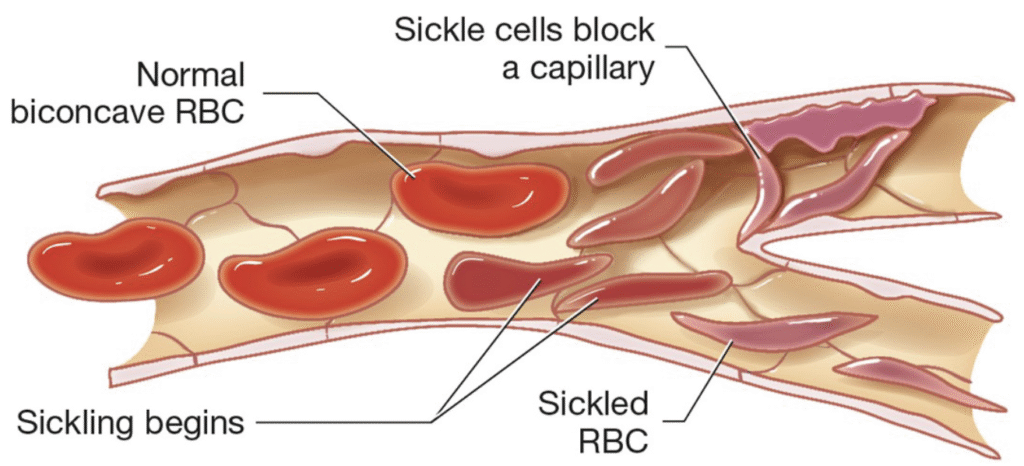
The abnormal crescent shape and sharp edges of these sickled erythrocytes are very different from the smooth, rounded contour of a normal erythrocyte.
Sickle cells do not move easily through the capillaries.
They become tangled and block the flow of blood. This causes severe pain and blood clots, particularly in the chest, abdomen, and joints.
Repeated sickling episodes cause these fragile erythrocytes to have a shortened life span, resulting in anemia
Transfusion Reaction
Reaction that occurs when a patient receives a blood transfusion with the wrong blood type.
Antibodies in the patient’s serum attack antigens on the erythrocytes of the donor blood, causing hemolysis of the donor erythrocytes.
Fever, chills, and hypotension occur almost immediately.
The person has flank pain because the fragments of the donor erythrocytes clog the kidney tubules.
A transfusion reaction can be fatal.
• trans- across; through
• fus/o- pouring
• -ion action; condition